Home•Stories•Insightful Articles
Mauritius is Losing Its Beaches. Can Local Action Outpace the Rising Sea?
From disappearing coastlines to coral collapse and economic strain, climate change is reshaping life on the island. But communities, farmers, and fishers aren’t waiting for the government to act.
Paradise Under Siege
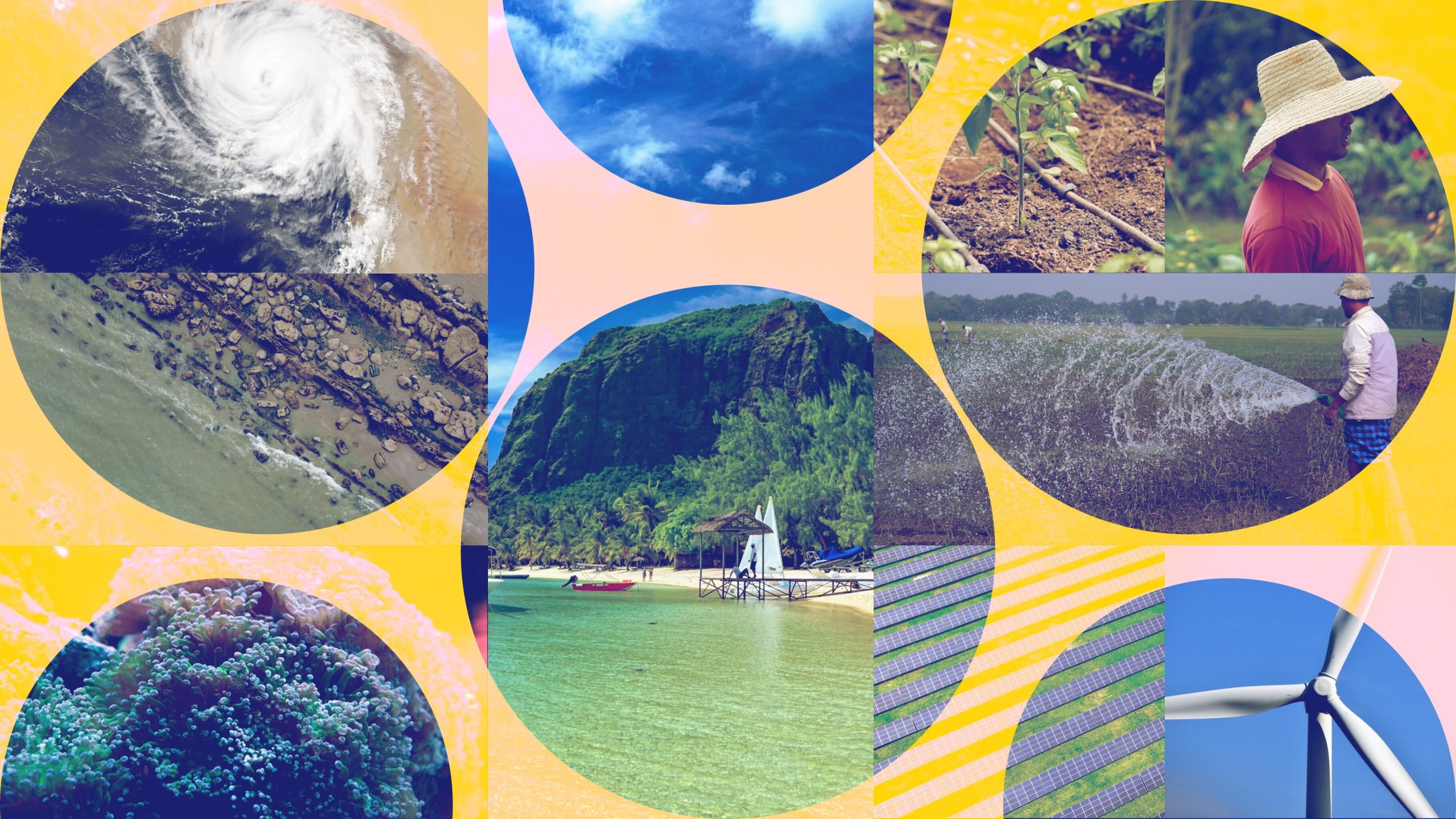
Every year, Mauritius loses up to 20 meters of shoreline. Sea levels are rising here at 8 millimeters annually, more than twice the global average. You don’t have to look far to see what’s at risk. White-sand beaches, coral reefs, and the calm blue lagoons that draw tourists from around the world are being eaten away, storm by storm.
This isn’t just about beauty fading. Cyclones and floods already cause $113 million in damages each year. In January 2024, over 100,000 people in Port Louis were affected by Tropical Cyclone Belal. The impact reaches deep into homes, roads, businesses, and jobs.
Mauritius ranks 104th out of 193 countries in the 2024 World Risk Report for climate disaster vulnerability. That might sound like a middle-of-the-road ranking, but for a small island that depends heavily on tourism and coastal infrastructure, the consequences are direct and personal.
Half the island’s beaches could disappear within 50 years. That means fewer jobs, more displacement, and rising costs. Mauritius is often celebrated for its economic resilience. But resilience can only stretch so far when the ocean won’t stop rising and the storms keep coming.
The ocean hasn’t only swallowed shorelines. It’s chipped away at sectors Mauritius built its economy on. Tourism, once a steady engine of growth, is now a fragile business. Resorts near the coast face growing risk as sea levels climb and beaches disappear, with over 10 meters lost in the past ten years alone. Tourists aren’t coming in the same numbers.
In February 2025, arrivals dropped by 12.1% from the year before. Just 95,991 visitors showed up compared to 109,266 in 2024. And that number speaks louder when you know how much the economy leans on them. A study from 2024 by the Stimson Center, the Commonwealth Blue Charter, and the Mauritius Ministry of Blue Economy, Marine Resources, Fisheries, and Shipping confirmed that climate-induced challenges, like the destruction of coastal ecosystems, severely impact tourism, a sector critical to the island’s economy.
Some of the damage hides beneath the surface. Coral bleaching has made diving and marine tourism less attractive. Visitors notice when reefs lose their color and fish disappear. Roads get flooded. Flights get delayed. Plans fall apart. Cyclones don’t check hotel calendars. Between October and May, storms hammer the island, causing $91 million in direct losses every year, about 80% of Mauritius' annual direct losses. Tropical Cyclone Berguitta in 2018 knocked out power to 6,800 homes and wiped out 80% of crops. In January 2024, Cyclone Belal hit with 105 mph winds, flooding streets and shutting down life. It’s hard to sell vacation packages when disaster feels this close.
Mauritius has already lost 13 kilometers of coastline to erosion since 1967. That’s 17% of its total. Damage from cyclones doesn’t stop when the winds die down. The losses ripple through every part of life. Flash floods like the one in 2013, where 152 mm of rain fell on Port Louis in a matter of hours, are now part of the country’s recent memory.
Agriculture tells its own version of this crisis. Sugarcane used to stretch across 80,000 hectares. In 2024, only 42,000 remain and that’s just sugarcane. Tea and other crops have all but disappeared. Sugar was once responsible for 23% of the country’s GDP. Now, it’s down to 4.4%. That said, it still counts. In 2023, raw sugar exports brought in $272 million, placing Mauritius 23rd in the world. The sector isn’t gone, it’s adapting. Farmers are shifting toward climate-resilient crops and smarter practices. Solar panels now power irrigation. Rainwater tanks dot the fields. EU-backed agroecology projects are helping raise yields by 30%, one farm at a time.
Mauritius didn’t stay stuck in sugar. Over the years, the economy stretched into tourism, finance, and tech. That shift looked smart, diversifying made sense. But now climate risks shadow those gains. The financial sector, built on trust and stability, doesn’t thrive when storms shut down roads or destroy infrastructure. International investors pay attention to these signals. Some banks have started funding renewable energy projects and climate-ready construction, but critics say the pace is slow and the effort feels thin.
Government-led climate finance projects show signs of progress. One $191 million effort, supported by the UNDP, targets 35% renewable energy by 2025. The Green Climate Fund also backed a $28.21 million plan to reach 60% by 2030. Some results are already visible—2,000 solar PV kits installed, 18 MW in battery storage online. Still, questions remain. Are these real moves toward resilience or just image management?
The island’s total climate finance needs are high, $7.47 billion. Adaptation alone makes up 60% of that. The gap between those needs and current action is wide. And while Mauritius still ranks high as one of Africa’s most business-friendly destinations, storms don’t check economic rankings before they hit.
Too Little, Too Late?
That dependence on foreign aid becomes harder to ignore when 65% of Mauritius’s $6.5 billion climate adaptation budget is expected to come from outside the country. International funding helps fill the gap as it actively participates in international climate negotiations, advocating for increased funding from institutions such as the UN Green Climate Fund and the World Bank. However, the strings often attached, plus the unpredictability of support, leave the island in a vulnerable position.
Mauritius has done its part in global forums. It has shown up, signed on, committed. At the 2025 “Cap sur la Finance Durable” conference, Bank of Mauritius Governor Dr. Rama Krishna Sithanen reminded the audience that, under the Paris Agreement, the country needs $6.5 billion in adaptation funds by 2030. But pledges don’t protect coasts. Delays in project implementation are still a real issue.
Progress has happened, but it’s scattered. The Metro Express, a light rail system designed to be low-emission, is one of the more visible symbols of green ambition. Still, critics say it doesn’t go far enough. Transportation remains just one part of a much bigger problem. Marine protection has also expanded: 30% of coastal waters now fall under some form of protection. But then what? Illegal fishing and pollution continue because enforcement remains weak.
The story repeats itself elsewhere. Construction to protect eroding beaches began in 2011, targeting 21 high-risk sites. Over a decade later, erosion hasn’t stopped—half a hectare of beach still vanishes each year. That’s not a small number when the economy relies on coastlines to bring in tourists and support marine life.
Mangrove restoration could offer a stronger natural buffer against erosion and flooding, but those projects remain underfunded. The same goes for many of the country’s nature-based solutions. The ambition exists. The follow-through feels thin. On paper, the island plans to reduce emissions by 40% by 2030. But how does that stack up against rising sea levels, hotter summers, and repeated flood events?
The partnerships Mauritius has built with China and India raise more questions than answers. Both countries are pouring money into green projects on the island. That’s helped kickstart development. At the same time, not everyone believes these contributions are purely environmental. Some point to geopolitical motives wrapped in climate cooperation. Whatever the driver, the risk remains: too much reliance on diplomacy, not enough local control.
There is movement within Mauritius too. Local businesses are beginning to push climate innovation. Startups like Ecoasis, a subsidiary of the ENL Group are trying to close the energy gap with cutting-edge solar solutions across sectors like textiles, hospitality, and real estate. Eco-tourism ventures and sustainable agri-tech are also gaining attention. These aren’t fringe ideas—they’re becoming more common. But 84% of energy use still comes from fossil fuels. That number has barely budged.
The government’s Renewable Energy Roadmap proposes a $1.35 billion investment by 2030 to change that. It’s ambitious, but again, execution matters more than planning. Public-private partnerships are growing, and EU-funded efforts have already brought some gains. Yet, no single project or business can scale fast enough to outpace rising risks.
Even now, some still ask if these strategies are reactive rather than forward-looking. Mangrove saplings and solar panels are helpful, but the real question is: can they do enough, soon enough? That tension between effort and impact runs through almost every climate action on the island. You can see the work being done. You can also see how much more is still missing.
Lives in the Balance
That gap between local action and institutional backing keeps widening. On one side, people are doing what they can—farmers shifting to agroforestry, fishers adapting to warmer waters, communities planting mangroves by hand. On the other, climate shocks keep hitting harder, and national systems aren’t always moving fast enough to keep up.
The lived experience here feels very different from policy meetings or budget forecasts. Rising sea levels and flash floods are already reshaping entire communities. According to the UNHCR, hundreds of families have been displaced because of coastal erosion. This isn't a future threat; it's already forcing people out of their homes. When flash floods hit in January 2024, they destroyed roads, submerged vehicles, displaced families, and claimed a life. Events like these are happening more often. And if housing and infrastructure don't adapt quickly, internal migration will strain inland towns and create new layers of inequality.
People are also being pushed out of their jobs. Tourism and agriculture, two pillars of the Mauritian economy, are both shrinking. Floods, droughts, coral bleaching, and erratic weather have hurt these sectors badly. With fewer visitors and less reliable harvests, jobs are disappearing. And for younger generations, this shift feels particularly unsettling. There’s a growing fear that the economy they were promised no longer exists.
You start to ask: Are people being trained for what’s coming? Not just for any job, but the kind that actually matches what the planet now demands. The 2024 LinkedIn Global Green Skills Report shows the global demand for green skills rose by 11.6% in just one year. But the supply of workers with those skills only grew by 5.6%. That’s not sustainable. By 2030, the report predicts one in five green jobs may go unfilled. For a small country like Mauritius, that mismatch could stall progress before it even starts.
The government has responded with vocational programs in renewable energy and conservation. But awareness and accessibility still need work. The education system has to do more than react. It needs to align fast with labor demands and economic shifts already underway. Getting young people into jobs that support both livelihoods and climate resilience will depend on how quickly these programs can be scaled up, made accessible, and tailored to actual needs.
In rural communities, people aren't waiting around. Many farmers have started combining traditional planting with agroforestry, helping reduce soil erosion while improving income. Global data backs this up: agroforestry can reduce soil degradation by 60–80% and boost farm earnings by up to 50%. In fishing villages, there's similar innovation. Artisanal fishers are turning to Fish Aggregating Devices to shift away from overfished areas and focus on pelagic species like tuna. These changes aren't just about survival; they’re strategic.
Programs like UNDP’s E€OFISH have helped too, installing solar-powered ice-making units to preserve fish quality and reduce waste. It’s a small upgrade that’s made a big difference. Same with grassroots mangrove restoration efforts—local NGOs and communities have taken the lead, organizing reforestation drives and sharing strategies across peer networks, a trend mirrored across sub-Saharan Africa.
These kinds of community-led solutions are working. But without more support from institutions, their reach stays limited. The knowledge is there. The willingness is there. What's missing is enough investment to take these efforts from the margins to the center.
Mauritius isn’t short on warnings. Rising seas are swallowing coastlines, reefs are dying off, and flash floods are becoming more violent. What was once a model for economic resilience among Small Island Developing States now feels exposed. The country’s celebrated diversification—tourism, agriculture, finance—is under climate pressure. And the pressure is growing fast.
Action needs to match the urgency already felt by communities losing their homes, fishers watching stocks collapse, and farmers pushed off land by drought or saltwater. The $6.5 billion adaptation gap won’t close itself. Neither will the 84% dependence on fossil fuels disappear without serious investment in renewables. The $1.35 billion Renewable Energy Roadmap is one step. It won’t work without long-term vision and strong local buy-in.
Funding from China, India, or the UN Green Climate Fund only matters if it reaches those who can actually use it well. That means faster project rollouts, more trust in local knowledge, and less bureaucracy. Green finance is a lifeline here.
The next few years will reveal whether Mauritius can move beyond declarations. Not everything rests with policymakers. Communities, businesses, and young people are already adapting. What they need now is support. This country still has the tools to lead. But leadership won’t come from hope. It comes from clarity, speed, and the will to act before the next wave hits harder than the last.
Written By
Gloria Edukere is a contributing writer at Susinsight, exploring systems and progress across Africa.
Filed Under