Home•Stories•Insightful Articles
Ghana’s Secondhand Clothing Trade Is Drowning in Waste. Here’s How to Save It.
A Waste-based Tax and Extended Producer Responsibility could keep jobs alive while tackling pollution at the source.
The Backwards Tax Story
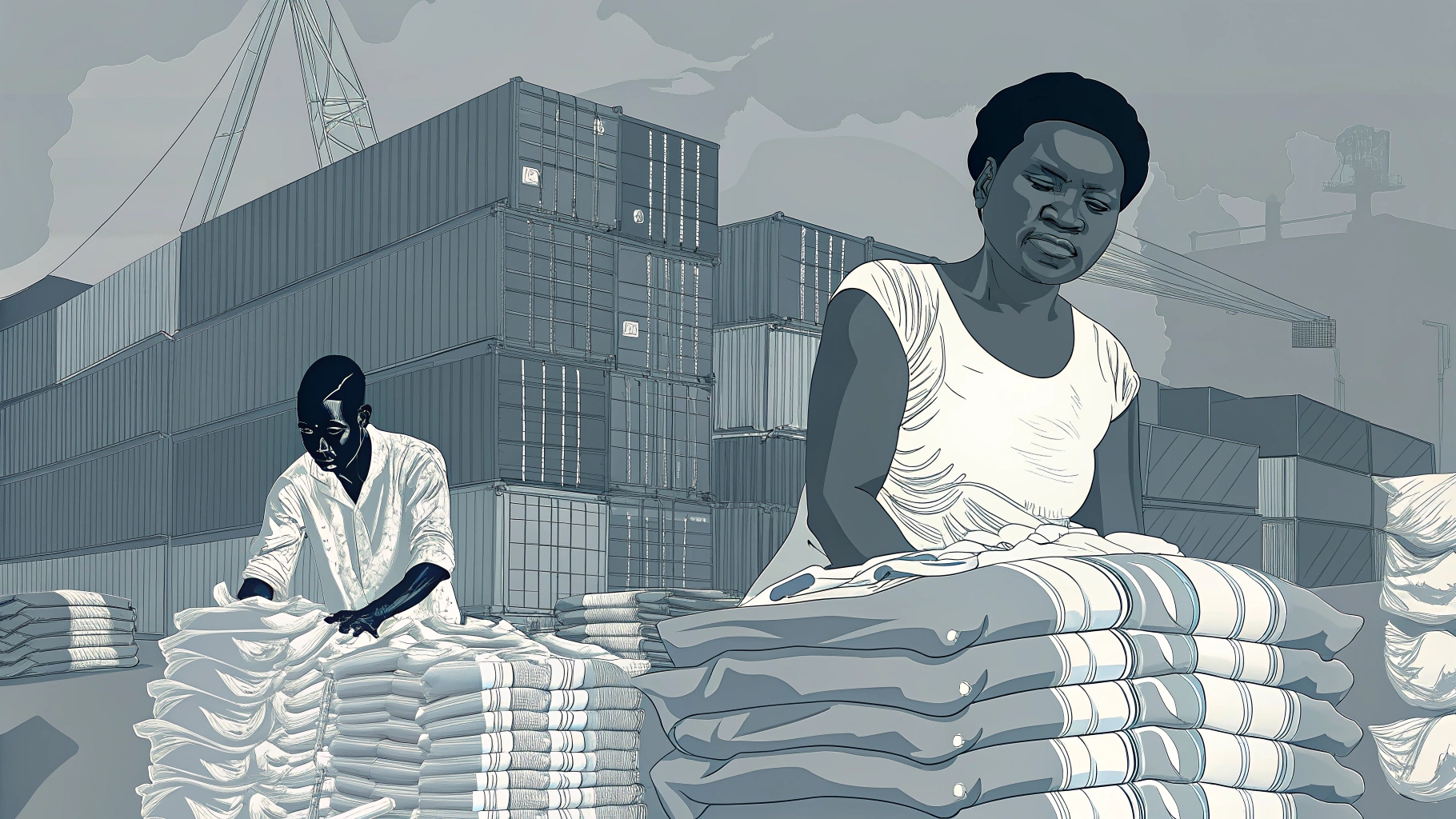
Every week, around 15 million secondhand garments arrive in Accra’s Kantamanto Market, mostly from Europe and North America. Traders dig through towering bales, knowing that 40%—about six million pieces—can’t be sold. These clothes are ripped, stained, or simply unsellable. They end up choking drains, piling in gutters, or washing onto the country’s beaches.
To tackle this waste, the government hiked import duties from GH¢15,000 to GH¢38,000 per 40-foot container. The aim? Cut down the flood. The result? Local traders suffer. Many are already operating on the edge, and now they pay more just to receive the same broken system. This feels backward. Exporters send the waste while Ghana pays to clean it up.
What if the burden shifted? A tax focused on textile waste—not volume—could push responsibility upstream. Funds raised could support repair workshops, fabric recycling, or community cleanups. Instead of punishing traders, Ghana could hold exporters accountable for dumping what they can’t sell at home.
Beneath the stacks of secondhand clothing at Kantamanto Market, the numbers tell a different story. Traders aren’t just trying to sell clothes, they’re trying to stay afloat. Since 2022, import duties have jumped by 153%. Combine that with the cedi losing value and prices rising across the board, and the strain becomes clear. The Ghana Used Clothing Association (GAUCA) has flagged this repeatedly. For many traders, especially smaller ones, there’s not much room left to absorb the cost.
Some have responded by downsizing or shifting into informal sales, which creates another issue. The more traders try to avoid these fees, the harder it becomes to track goods, regulate the flow, or collect revenue. Others are leaving the trade entirely. Reports say up to 70% of secondhand clothing dealers are at risk of shutting down. This doesn’t just affect them, it hits consumers too. The middle class, particularly those who rely on “first selection” clothing for office wear and daily use, are feeling the squeeze. Prices are up, options are down.
At the same time, the clothes keep coming. Most are low-grade. Bale prices, which once reached GH¢23,000 in 2022, now hover between GH¢6,500 and GH¢7,000. Traders are receiving less in both quantity and quality, but waste is rising.
Each day, Kantamanto Market alone deals with more than 100 tonnes of textile waste. That’s about 40% of all imported garments, according to civil society groups and independent researchers. The Ghana Used Clothing Dealers Association (GUCDA) disagrees, claiming waste makes up less than 5%. Even if that lower estimate holds, disposal is still expensive and traders are left to deal with it. Some pay to have it dumped. Others burn it. Either way, the result is pollution in rivers, along coastlines, and across landfills. No exporter cleans it up. No brand takes responsibility.
Making Makers Pay
Shifting the cost of textile waste to those who generate it feels more honest than expecting small traders in Kantamanto to clean up fashion’s leftovers. Around 15 million secondhand garments enter Ghana each week. Close to 40% end up as waste. Traders unpack bales knowing that nearly half the contents may be worthless. Yet they still pay the full duty. That disconnect has sparked growing interest in a textile waste levy, not just on the volume of imports, but on the quality and outcome.
A waste-focused tax could hold exporters and manufacturers accountable for the items they send, especially those offloading low-grade stock into markets like Ghana. Unlike the current flat-rate duties, this approach targets the actual problem. It also opens up funding for local solutions. Textile repair shops, recycling hubs, training programs—these ideas aren’t abstract. They’re essential.
Oliver Boachie from Ghana’s Ministry of Environment believes this direction could create real jobs and build a fiber-to-fiber recycling industry. It’s not just about sorting old clothes. Workers could be upskilled to turn waste into new materials. That means jobs in sorting, processing, spinning recycled yarn, or even launching new businesses from discarded fabric.
There’s no fantasy here. To work, this kind of policy needs infrastructure—sorting centers, transparent tracking systems, maybe even tiered fees based on waste volume or material type. Without these, the risk is that traders or consumers still end up footing the bill.
Extended Producer Responsibility (EPR) schemes, used in parts of the EU, offer one model. They require brands to share the cost of managing the waste their products create. Ghana doesn’t need to copy those systems outright, but the principle applies. Push responsibility upstream. Track what comes in. Build support for what stays behind. The shift won’t be easy. But focusing on waste, not just trade volume, could change how this entire system works.
Building on those models means thinking beyond taxation alone. Extended Producer Responsibility (EPR) offers a different way to share the cost of fashion waste. Instead of local traders and governments footing the cleanup bill, producers, especially those making or exporting clothes, would be required to take responsibility for what happens after use.
EPR isn’t a new idea. OECD countries have used it for years to manage waste from electronics, packaging, vehicles, tyres, and, more recently, textiles. In practice, it shifts both cost and accountability from the public sector to producers, while giving them a reason to rethink how products are made. If a brand knows its fees will be higher for clothing that’s hard to recycle, it might redesign the product from the start.
France was the first to try this with clothing. Since 2007, its textile EPR scheme has channeled over €150 million into repairs and reuse. Brands that produce longer-lasting, recyclable garments pay less in fees. France now aims to reach a 15% local reuse rate by 2027. Sweden is following with its own textile EPR law launching in 2025. There, retailers will pay waste management fees based on how much they sell and how eco-friendly their products are. The money goes into building collection systems and funding waste infrastructure.
Kenya is experimenting too. Building on its experience with plastic recycling and clean energy, Kenya is investing in fiber-to-fiber recycling and product redesign. Government, business, and development partners are working together to align with EU standards on textile waste.
Ghana could carve its own path here. With growing imports of used clothing and no formal system to collect what’s discarded, the pressure builds quickly. An EPR law tailored to Ghana’s context could hold both domestic and foreign producers responsible for their garments after they’re worn or not worn at all. But for this to work, Ghana would need more than legislation. Enforcement is tricky when most waste flows through informal channels, data systems are limited, and public understanding of post-consumer waste is still developing.
Countries like France and Sweden didn’t get here overnight. Ghana’s approach would need to reflect local realities while learning from others who’ve gone ahead. That means investing in public education, building partnerships, and making space for those already working on the ground.
The Real Work Begins
These conversations around EPR are happening alongside another heated debate—what to do about secondhand clothing imports. Some argue for a full ban. Their reasons aren’t hard to understand. Dump sites are overflowing, local textile producers are struggling, and cheap, poor-quality garments keep arriving in bulk. For these voices, banning imports seems like a direct way to protect local industry and reduce the waste load. Environmental advocates have added pressure, pointing to water pollution linked to textile dumping.
But others, including The Or Foundation and local community groups, see danger in that kind of blanket policy. Markets like Kantamanto in Accra depend on secondhand clothing to survive. Over 30,000 jobs are connected to that trade. Banning it could wipe out income for thousands and limit access to affordable clothing, especially for low-income families. According to them, the real problem isn’t the imports—it’s the unregulated flow of low-quality waste clothing and the lack of accountability from fast fashion brands that overproduce and offload what they can’t sell.
So instead of picking sides, the smarter move may be to balance environmental goals with social realities. The Or Foundation suggests using EPR as the policy anchor. That doesn’t mean giving up on regulation. It means expanding EPR alongside targeted import rules, tax incentives, and infrastructure investments that support the whole cycle, from entry to disposal.
Incentivizing textile recycling and upcycling through tax breaks could give businesses a reason to innovate. Public awareness campaigns can help shift consumer behavior. Tightened import rules—tariffs, sustainability checks, and product quotas—can slow the flood of low-grade fashion. And public-private partnerships will be key. The Kumasi Compost and Recycling Plant (KCARP) already shows how this kind of collaboration can scale. Projects like The Revival, which turns textile waste into fashion, add another piece. These aren’t just cleanup efforts, they’re examples of what creative, local solutions can look like when they’re backed with the right tools.
Ghana doesn’t need to follow a script written elsewhere. Taxing textile waste instead of punishing secondhand imports offers a more honest, targeted approach. This shift could support jobs, strengthen local businesses, and hold the right players accountable, especially fast fashion brands exporting low-quality clothing. Waste-based levies and Extended Producer Responsibility (EPR) policies would push manufacturers to think beyond profit margins and design for longevity, repair, and reuse.
Local and international brands working in Ghana can lead by example. They can commit to lower production, share transparent waste data, and fund recycling or take-back programs. EPR, if done well, turns waste into opportunity and makes room for real innovation. To get there, lawmakers need to move quickly. Waste taxation and EPR shouldn’t be side projects; rather, they should anchor textile policy going forward. These tools can help build systems that reward care, not speed.
The real challenge now is simple: can the people shaping this system work together to make responsibility the standard, not the exception? Everything else depends on that.
Written By
Ezinne Okoroafor is a contributing writer at Susinsight, exploring systems and progress across Africa.
Filed Under