Middle East War Pushes Up Fuel Costs Across Africa
After the February 28, 2026 US–Israel strikes on Iran, disruption in Hormuz and Bab el-Mandeb pushed freight surcharges to $4,000 per container and drove up fuel prices across Africa.
Current events rarely stay inside their own borders. A war that began on February 28, 2026, with joint United States and Israeli airstrikes on Iran, now stretches across the Middle East and into global trade routes that African economies depend on every day. The initial strike killed Iran’s Supreme Leader Ali Khamenei along with numerous officials and targeted missile sites, air defenses, and nuclear-related infrastructure such as Natanz across 26 Iranian provinces. Washington and Tel Aviv framed the operation as an attempt to neutralize military threats and trigger regime change, a timeline tracked in detail in regional video briefings. The result has been the opposite of containment.
Retaliation followed quickly. Iran launched more than 500 ballistic missiles and about 2,000 drones toward Israel and United States bases across the region. Israeli reports say those attacks caused about 13 deaths, while the United States confirmed 8 soldiers killed. Iranian casualties from the bombardment exceed 2,400, including civilians. Schools, hospitals, and cultural sites have been struck. One attack damaged areas near Golestan Palace, a UNESCO site. Launch activity dropped sharply by March 10, with missile and drone launches declining 90 to 92% after many launchers were destroyed and stockpiles depleted. Fighting continues with no clear end in sight, even as some analysts use open-source videos to track claims and strike patterns.
The conflict did not remain contained between the three states. Iran widened the battlefield in an unprecedented move, striking every Gulf Cooperation Council country. Targets in the United Arab Emirates, Saudi Arabia, Qatar, Bahrain, Kuwait, and Oman included airports, oil facilities, United States bases, and civilian areas, a pattern described in current war reports. Gulf defense systems intercepted roughly 50% of the attacks. Energy markets reacted instantly. War-risk surcharges appeared across shipping contracts. Tensions around maritime routes pushed traffic out of the Strait of Hormuz, one of the world’s most important oil corridors. More than 150 ships became stranded in the waterway, a situation closely watched by regional shipping observers.
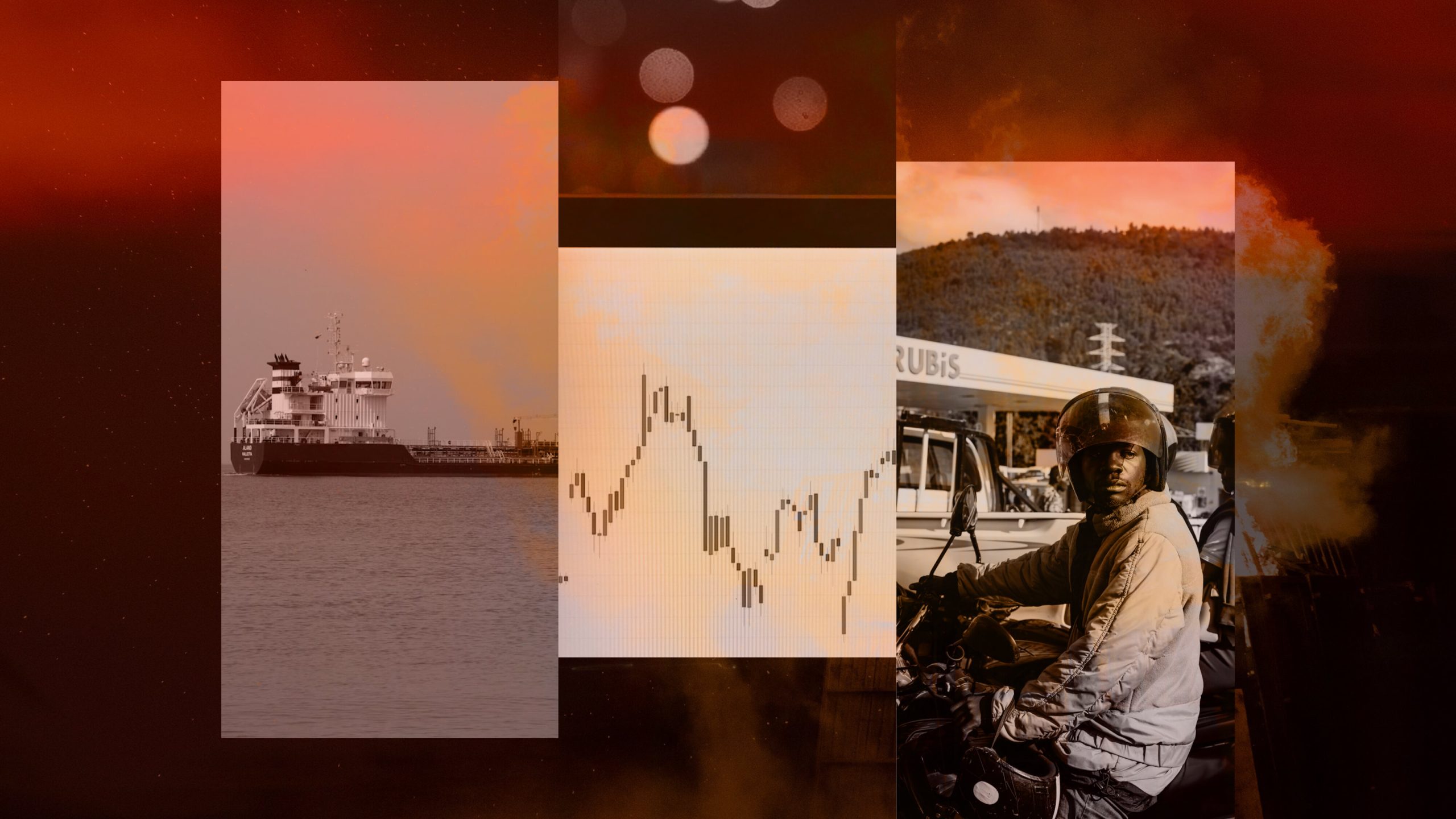
That maritime disruption has already started rippling far beyond the Middle East. Trade routes linking Asia, Europe, and Africa rely heavily on the Strait of Hormuz and Bab el-Mandeb. When instability hits both passages at the same time, shipping companies begin rerouting vessels around the Cape of Good Hope, adding 10 to 14 days to some journeys. Major carriers such as Maersk and MSC have suspended some Hormuz and Red Sea routes, according to trade reporting. MSC introduced a $4,000 surcharge for refrigerated containers on Gulf-to-Africa routes. Shipping delays and higher insurance premiums have started feeding directly into fuel markets, with analysts warning that the effects go far beyond oil prices.
Some African governments felt the shock immediately. Tanzania held an emergency fuel summit on March 4 and 5 after global oil prices climbed about 13% during the early days of the war, a move echoed in local market coverage. Price changes followed quickly in other places. South Africa’s petrol rose by 20 cents per litre, while diesel increased by 62 to 65 cents per litre on March 6, trends that farmers and retailers now feel directly, as industry reports have started to note. Fuel ministers across the region now warn that longer disruptions could push global oil prices above $100 per barrel, a threshold that African commentators in regional forums also flag as a political and social risk. African economies remain exposed because roughly 20% of the world’s oil supply moves through Hormuz, and many countries import refined fuel through those shipping lanes.
Regional fighting adds further uncertainty. Hezbollah resumed attacks on northern Israel on March 2, firing missiles and drones, a development tracked in conflict analysis. Israeli forces responded with more than 250 airstrikes across Lebanon, killing about 50 people and hitting weapons depots and commanders near Beirut. Total deaths in Lebanon linked to the escalation have reached 486. Israeli leadership authorized a ground invasion on March 3, sending forces deeper into southern Lebanon. Lebanese officials have since raised the possibility of negotiations focused on Hezbollah disarmament.
Gaza and the West Bank have also been pulled deeper into the conflict. Israel closed all Gaza crossings after the strikes on Iran, tightening a siege that already followed a stalled October 2025 ceasefire. Aid deliveries slowed while military operations continued. Raids in the West Bank persisted, including the closure of the Al-Aqsa Mosque compound, a situation described by regional correspondents. Hamas condemned the attacks on Iran while remaining silent on Iran’s strikes against Gulf states.
Other fronts remain volatile. Yemen’s Houthi movement announced plans to resume attacks on Red Sea shipping, describing the move as support for Iran, though only limited action has followed so far, according to shipping and security updates. Israel and the United States previously struck Houthi leadership positions, which may explain the cautious response. Iranian-aligned Popular Mobilization Forces in Iraq suffered strikes that killed more than 10 fighters. Air attacks also targeted crossings linking Syria and Lebanon. Smaller incidents have been reported in Turkey, Azerbaijan, and Cyprus.
Diplomacy has struggled to catch up with events. Emergency meetings at the United Nations Security Council have condemned the escalation, with meeting summaries detailing calls for restraint and de-escalation. Military costs for Washington alone now range between $890 million and $1 billion per day. Meanwhile, the African Union Commission, led by Chairperson Mahmoud Ali Youssouf, called for restraint on February 28, the day the war began, in an official press statement. Several African governments issued their own statements. South Africa and Senegal questioned the legality of the strikes, while Nigeria and Ghana urged caution and tried to maintain balanced diplomatic positions, positions reflected in African-focused coverage. Chad adopted a similarly cautious tone because of security partnerships with Gulf states, a reality that regional newswires have linked to cross-border security and remittance flows.
Shipping and energy disruptions show why African diplomacy cannot treat the conflict as distant. Trade routes crossing the Red Sea and Hormuz connect African ports to Asia and Europe, links that Middle East and Africa analysts at regional research centers have warned about for years. Rising insurance costs and shipping delays raise food and fuel prices across import-dependent economies. Citizens studying or working in the Middle East have also faced evacuation risks. Governments must respond quickly when global crises trap their nationals abroad or disrupt supply chains, a point echoed in early policy debates.
Longer conflicts create space for practical policy changes. African governments have already begun discussing regional fuel reserves and diversified supply routes. Energy ministers in several countries argue that strategic stockpiles could cushion future shocks, an idea that reappears in energy market analysis. Diplomatic channels with Gulf states may also provide leverage. The same Gulf economies under missile attack host millions of African workers whose remittances support families back home. Quiet mediation could protect both economic ties and regional stability, as argued in earlyeditorials calling for a coordinated African response.
A war launched on February 28 has already altered shipping lanes, energy prices, and diplomatic calculations across multiple continents. That reality offers a clear lesson for policymakers watching from Africa. Strategic reserves and diversified trade routes matter long before a crisis arrives. Governments that treat distant conflicts as someone else’s problem usually discover the bill arriving later through higher fuel prices and disrupted imports, a pattern that journalists and analysts across the continent, from Dar es Salaam to Johannesburg, have started to document in real time. Preparing for that reality today may prove more valuable than reacting once another convoy of ships stops moving through Hormuz.
Written By
The Trending Desk delivers timely headlines and insights on the stories shaping Africa's future.
Filed Under