Home•Stories•Insightful Articles
Reimagining the Great Green Wall
To succeed, the Great Green Wall must approach the Sahel’s restoration by going beyond tree planting to prioritize native species, soil regeneration, and local community leadership.
When Green Turns Gray
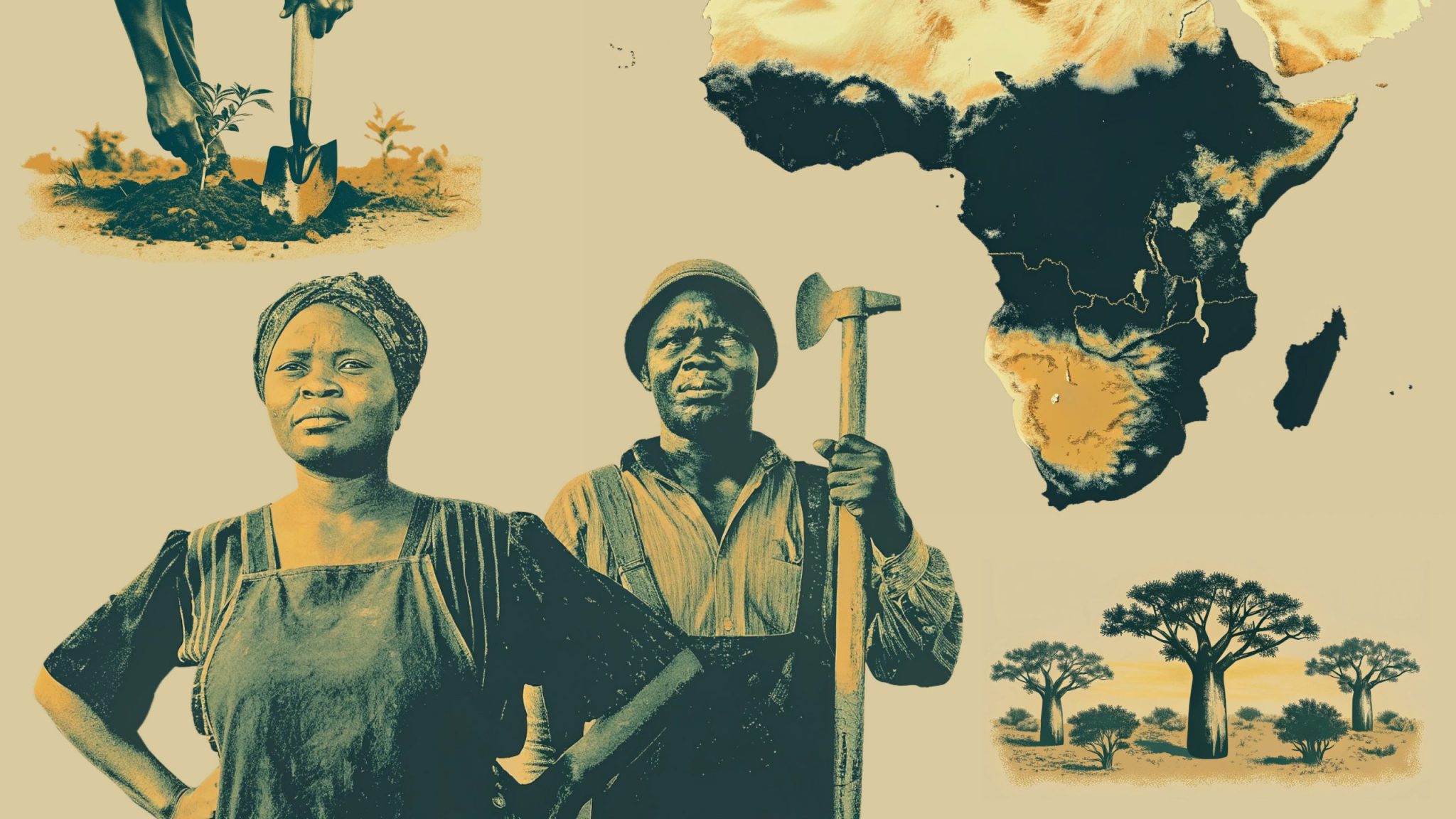
The Sahel, an 8,000-kilometer belt stretching across Africa’s southern Sahara, is often described as a place of extremes. The sun beats down relentlessly, and when rain does come, it arrives in violent bursts, carving deep scars into the earth. Amid this harsh reality stands an unsettling sight—rows of dead trees, brittle and leafless, stripped of life.
These “ghost forests” are what remains of the Great Green Wall Initiative (GGWI), a project launched in 2007 by the African Union with a sweeping vision: halt desertification, restore degraded lands, and create sustainable livelihoods. Millions of trees were planted to reclaim the Sahel from encroaching desert, but many have not survived. Instead of a thriving green belt, vast stretches remain barren, the trees’ skeletal remains a quiet indictment of what has gone wrong.
This shortcoming is not just about trees. The GGWI was never supposed to be just a tree-planting campaign. It was meant to tackle some of the Sahel’s deepest problems: climate change, food insecurity, and poverty. The numbers reflect the ambition: 100 million hectares restored, 250 million tonnes of carbon dioxide sequestered, and 10 million jobs created by 2030. However, by 2020, only 4% of the goal had been achieved. In some areas, mortality rates among planted trees are alarmingly high. Why? Poor planning? A flawed strategy? Or is the entire model fundamentally misguided?
What happens in the Sahel does not stay in the Sahel. If the GGWI stumbles, it could shake confidence in large-scale ecological restoration projects worldwide. Meanwhile, desertification continues to claim 12 million hectares annually, and as farmland disappears, poverty and food insecurity deepen. Understanding why these trees are dying isn’t just an academic exercise. It’s an urgent question for anyone who believes environmental restoration can work. If the Great Green Wall fails, what does that mean for the future of global reforestation efforts?
The Sahel’s ghost forests bear silent witness to ecological mismatches and human miscalculations. Average temperatures have risen by 1.3°C since 1901, while annual rainfall has dropped by up to 30%. These shifts create a lethal cycle—droughts from 1968 to 1972 weakened root systems, and extreme heatwaves, now more frequent, kill saplings before they take hold.
The drought wiped out nearly all crops and claimed 50–70% of livestock. By 1973, the Sahara had advanced 60 miles south. As aridity intensified and human populations grew, tree cover declined, especially in the western Sahel, where satellite data shows a 32% drop in density. Some efforts to restore vegetation have backfired. Exotic species like Eucalyptus camaldulensis were widely planted for their fast growth but ended up reducing herbaceous plant biomass by up to 75% through allelopathic chemicals. In parts of Sahelian West Africa, these non-native trees increased greenery but displaced native vegetation, fueling what some call the ‘green desert’ effect. Meanwhile, hardy indigenous species like Faidherbia albida and Balanites aegyptiaca, which improve soil fertility and survive in harsh conditions, were often overlooked.
Soil degradation worsens these setbacks. Wind erosion strips 45.9 tons of topsoil per hectare annually, erasing two decades of soil formation in a single rainy season. Nutrient-poor lateritic soils, covering 65% of farmland, become ecological traps where tree roots starve in aluminum-saturated substrates and compete with crops for phosphorus.
Human oversights in project design have only deepened these challenges. Between 2010 and 2020, the rush to meet planting targets led to “dig-and-dump” campaigns where tree survival rates plummeted due to poor species-site selection. Large-scale, top-down approaches ignored proven local agroforestry methods like Farmer-Managed Natural Regeneration (FMNR), which naturally increases tree density by protecting regrowth. Meanwhile, ongoing land and water disputes between farmers and herders continue to disrupt agriculture and tree management, adding yet another layer of instability to the region’s fragile ecosystems.
Beyond Planting, Start Growing
Amid the challenges faced by the Great Green Wall Initiative (GGWI), successful restoration efforts in the Sahel offer valuable lessons for rethinking ecological restoration strategies. One such approach, agroforestry, has demonstrated remarkable success in blending trees with crops and livestock.
In Niger and Burkina Faso, farmers have embraced Farmer-Managed Natural Regeneration (FMNR), a practice that nurtures native tree species already present in the soil rather than relying on labor-intensive replanting. This method has restored over 5 million hectares of land in Niger, significantly improving soil fertility and crop yields while reducing costs.
FMNR has driven the restoration of about 200 million trees, spreading at a rate of 250,000 hectares per year over twenty years with little or no external support in Niger. This approach has helped mitigate drought, poor soil fertility, low yields, and fodder shortages. Similarly, in Burkina Faso, farmers have restored about 430 hectares of forest dominated by local species, yielding ecological and economic benefits, including improved food security and plant cover.
Another critical lesson lies in the use of drought-resistant native species, which are better adapted to the Sahel’s arid conditions. In Ethiopia and Mali, communities have successfully planted species like acacia and baobab trees, which thrive in low-rainfall environments due to their extensive root systems and high water retention capacities. Ethiopian farmers frequently plant Acacia for their ability to enhance soil fertility, grow quickly, and provide economic value, making them an essential tool for reversing land degradation. The African baobab (Adansonia digitata) has been widely cultivated in Mali, stabilizing degraded soils while offering nutritional benefits through its leaves and fruit.
Water-harvesting techniques have also played a significant role in improving tree survival rates. Traditional methods such as “half-moon” trenches and stone bunds, effectively capture rainwater and prevent runoff. These structures collect and retain water, reducing erosion and increasing soil moisture. In southern Niger, areas with half-moon interventions have seen nearly a 50% increase in vegetation greenness, highlighting their effectiveness in supporting tree survival.
These successes emphasize the importance of tailoring restoration efforts to local ecological and cultural contexts. Prioritizing native species, leveraging traditional knowledge, and integrating water management innovations offer a blueprint for resilient reforestation in the Sahel. Rather than focusing solely on planting trees, these approaches prioritize building ecosystems that can endure harsh conditions while sustaining local communities.
Shifting the focus from tree planting to soil regeneration, water conservation, and sustainable land management is the only way forward for the Great Green Wall Initiative (GGWI). The African Union’s revised GGWI Strategy (2024–2034) acknowledges this shift, recognizing the need for climate-smart agriculture, nature-based solutions, and land restoration that strengthens local livelihoods instead of sidelining them.
Soil science, water retention techniques, and responsible livestock grazing are not afterthoughts—they determine whether degraded land can be revived or left barren. In Tigray, Ethiopia, rangeland rehabilitation has succeeded because restoration efforts prioritized water harvesting and sustainable grazing rather than just tree planting. Without these elements, even the most ambitious afforestation efforts fail before they begin.
Empowering local communities is just as critical. The GGWI’s revised strategy calls for “community-led land restoration,” an overdue recognition that top-down projects often alienate those who depend on the land. Niger and Burkina Faso have already demonstrated that restoration efforts work best when local farmers and herders take the lead. A flagship project in these countries is expanding this model by strengthening local decision-making and ensuring communities control their restoration investments.
The initiative “supports green entrepreneurs to ensure the implementation of sustainable restoration investments and provides multiple benefits to the most vulnerable populations,” said Christophe Besacier, coordinator of the FAO’s Forest and Landscape Restoration Mechanism.
Restoration efforts must go beyond tree planting and provide lasting economic opportunities, such as agroforestry programs and carbon credit schemes. Amadou Aboubakar of the African Wildlife Foundation echoes this, arguing that long-term success depends on direct community participation. Without it, projects fail as soon as external funding dries up.
Securing land rights for pastoralists and small-scale farmers is equally urgent. When communities lack legal tenure, they have little reason to protect or invest in restored land. The African Union now acknowledges this, emphasizing “just and equitable transitions” that formalize traditional land-use rights rather than displacing people in the name of conservation.
Better monitoring is also long overdue. The Great Green Wall Initiative (GGWI) has pledged to restore 100 million hectares by 2030, but tracking progress largely relies on self-reported data. Satellite imagery and Artifical Intelligence could change this by identifying tree mortality, soil degradation, and water retention failures in real time. Remote sensing could pinpoint where exotic species like eucalyptus are draining groundwater, allowing for rapid intervention.
The program cannot afford to repeat past mistakes. Restoration is not about hitting a tree-planting quota—it is about rebuilding ecosystems that can sustain both people and nature.
Whose Wall Is It?
The Great Green Wall Initiative has been championed as a bold solution to combat desertification and restore degraded lands across the Sahel. But beneath its ambitious vision lies a tangle of political and economic roadblocks that shape who controls and benefits from the initiative. One glaring issue is the gap between financial commitments and real action. Over $50 billion is estimated to be required for the GGWI’s success by 2030. Since 2007, $19 billion has been pledged, with $14.3 billion announced at the 2021 One Planet Summit alone. Yet, by March 2023, only $2.5 billion had been disbursed—most of it stuck in bureaucratic limbo, delaying tangible impacts for the communities that need it most.
Land ownership conflicts further complicate progress. In several regions, tensions between local pastoralists and government bodies have intensified over access to reforested lands. Pastoralists, who rely on open grazing areas, are often excluded from territories designated for tree planting. Their exclusion has fueled claims that the Great Green Wall Initiative prioritizes tree coverage over people’s land rights. In areas already burdened by poverty and displacement, these policies have sown frustration rather than fostering cooperation.
The question of who benefits from reforestation exposes deeper fault lines. Private-sector involvement has brought funding and expertise but also heightened concerns over corporate land acquisitions disguised as conservation efforts. Some companies see the initiative as a chance to secure vast tracts of land under the pretext of ecological restoration, sidelining local communities in favor of profit-driven ventures. Certain NGOs have also drawn criticism for prioritizing high-visibility tree-planting campaigns that cater to donor expectations rather than ensuring long-term sustainability.
Independent research and civil society reports highlight instances where tree-planting schemes mask land grabs and human rights violations. In some cases, NGOs and private institutions have displaced communities, exacerbating existing environmental and social vulnerabilities. Local farmers in the Republic of Congo, for example, claim that Total’s tree-planting project has stripped them of their fields and jeopardized their livelihoods. These grievances challenge the prevailing narrative that afforestation efforts inherently benefit the people they claim to help.
The Great Green Wall’s political complexities reveal a troubling disconnect between high-level ambitions and on-the-ground realities. While addressing climate change, food insecurity, and land degradation is essential, mismanagement and competing interests have diluted the initiative’s impact. Without stronger governance that prioritizes local voices, the GGWI risks becoming less of a solution and more of a spectacle—another grand environmental promise failing to deliver where it matters most.
The Great Green Wall is at a breaking point. Will it continue as a fragmented tree-planting effort, or will it evolve into something more? The answer decides if this project revives the Sahel or becomes another failed environmental promise.
Planting trees is not enough. The Sahel’s problems—desertification, food insecurity, displacement—require deeper solutions. Restoring degraded soil, securing land rights, and investing in sustainable water management must take priority. This is not just about trees but about people, livelihoods, and ecosystems that can survive long after foreign aid dries up.
Governments must step up, not just with pledges but with policies that protect local communities. Scientists need to focus on what works—restoring native vegetation, improving soil health, and designing climate-smart agriculture. Businesses and investors must move beyond short-term gains and support green economies that benefit both people and nature. And the public? Accountability starts from the ground up. Demand results. Challenge empty promises. Support real solutions.
Africa’s largest environmental effort does not have to be its biggest failure. But change won’t happen through slogans. If nothing shifts, the Great Green Wall will be little more than a fading line on a map—a monument to lost potential.
Written By
Adetoro Adetayo is a contributing writer at Susinsight, exploring systems and progress across Africa.
Filed Under