Why WhatsApp Voice Notes Are Becoming Tanzania’s Farming Lifeline
Cheap, accessible, and personal: audio messages are helping farmers act quickly and learn from each other.
Author
Editors
Published
September 3, 2025
Read Time
9 min read
The Sound Before Text
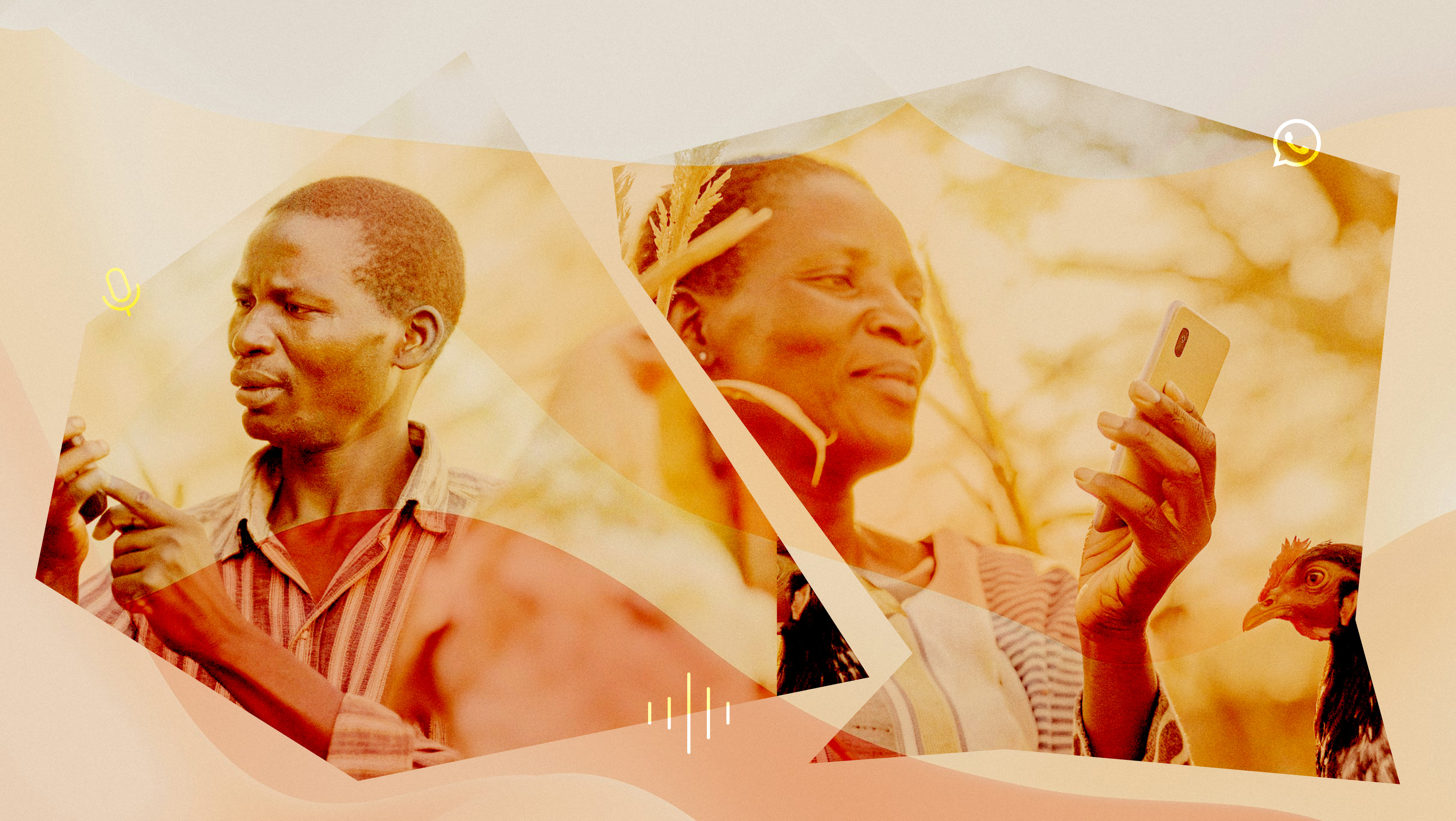
Over 33 million Tanzanians are mobile internet subscribers, and more than half of Arusha’s small-scale poultry farmers use WhatsApp regularly. These acts of knowledge-sharing, shaped by lived experience and adapted for digital life. Even in places where reading and writing are a challenge, a simple voice message reaches farther than paper ever could. Across rural areas, elders—once limited to village gatherings—are now heard across regions. They don’t need fancy apps or strong signals. Just a phone, and their voice. That’s enough.
In Tanzania, where over 55 million people now use the internet, the app isn’t treated as some flashy innovation. It fits because it works. Among 130 small-scale poultry farmers surveyed in Arusha, 66—just over 50%—used WhatsApp more than 16 times a month. That’s more than once every other day. The reason? It makes sense for people juggling poor connectivity, expensive data, and spotty roads.
Voice notes are at the center of this shift. They're short, personal, and in the languages people speak every day. Someone might ask a question about a coughing chicken, and hours later, an elder replies with what’s worked for years. These messages pass on something more than instruction. They carry tone, familiarity, even urgency—things a textbook or PDF can't manage.
Unlike government extension officers—who sometimes have to serve thousands of farmers across wide rural zones—WhatsApp is always “on.” Advice doesn’t wait for a visit. It doesn’t depend on travel budgets or printed manuals. Farmers don’t need to wait weeks. Instead, they send a message to the group and check their phone later to find five suggestions from people just like them. Some of these farmers know the soil type or rainfall patterns better than any expert.
WhatsApp also makes space for different kinds of expertise. It brings together farmers who know the traditional techniques with others testing new ones. Someone might share a price they got at the market, while another sends a photo of a pest damaging their crops. These everyday exchanges fill the gap left by formal systems. They’re timely, direct, and grounded in what’s actually happening. Even NGOs and government programs are paying attention. They’ve started to experiment with using WhatsApp too—not as a replacement for their programs, but to extend them.
Breaking the Silence
You hear it before you read it. A voice, not a report. A question, not a form. That’s how many farmers in rural Tanzania experience agricultural advice today. Text doesn’t always reach the people who need help most. Adult literacy might be around 83% nationally, but in many villages, especially among older adults and women, reading and writing are still out of reach. WhatsApp voice notes shift the format—making knowledge feel familiar, not foreign.
Elders now send messages in Kiswahili or indigenous languages like Sukuma and Hehe. They talk about how they’ve handled cassava rot or how they mix herbs to keep pests off their maize. You can see this shift in action through projects like Farm Radio International’s “Her Voice on Air.” In Singida, farmers use missed-call systems to record questions and share tips. Women, who often sit outside formal extension programs, now send voice messages and get replies within days. Zaina Issa, one participant, used to wait months for help. Now, the maize she grows yields more. She’s not just receiving advice—she’s part of the conversation. Even an evaluation by Viamo found that 69% of farmers who engaged with voice-based radio advise put what they learned into practice.
In Mtwara, the Ushauri service follows a similar idea. Farmers leave audio questions about pests or land prep. In one month alone, 154 voice queries were recorded and answered. Among those users, 64% adopted new pest control methods within three weeks. That kind of quick change is rare in traditional programs.
Behind the scenes, a network of NGOs, startups, and farmer groups is making sure elders are not only heard—but supported. These efforts aren’t uniform. They’re local, often experimental, and constantly adapting. Inades Tanzania, for example, takes a practical approach. They build local WhatsApp groups and combine them with on-farm training. The goal isn’t to replace fieldwork but to link it with daily communication. Since starting, they’ve reached 17,223 people and worked with 134 organizations. Elders are shown how to record short updates about pests or crop rotation, which they then share directly in these groups.
HIMA (Hifadhi Mazingira) builds on this. Their field officers help elders record voice notes in their own languages. These aren’t interviews—they’re short, straight-to-the-point tips from people who’ve seen the same soil change over decades. The messages are shared in farmer groups, creating a peer-to-peer rhythm that feels more like a village conversation than a training session.
TechForward Tanzania and Kilimotech, led by Elias Patrick, offer something different. Kilimotech developed a WhatsApp-based chatbot that gives instant feedback. Farmers can ask about market prices or snap a photo of a crop disease. The bot replies in Swahili or English. It doesn’t pretend to replace humans. It helps fill in the silence between them. KIHATA (Kilimo Hai Tanzania) runs workshops focused on elders. Using Kiswahili, they teach simple smartphone skills. Through their KHEA project, they use the ToToF method—Training of Teams of Facilitators—to expand impact. So far, they’ve supported over 1,600 users this year. These sessions also emphasize how to use voice notes in family and neighborhood groups, reinforcing local learning.
Viamo and the Farm to Market Alliance (FTMA) are testing a new idea. Their AI-powered Voice Companion works on basic mobile phones and responds to open-ended questions in local languages. The plan is to pilot it with 5,000 sunflower farmers across northern and southern Tanzania. The aim: a 20% yield boost through tailored advice. In Zambia, they tried the same assistant with 500 farmers. Within three weeks, 62% had opted in and sent 555 questions. That number had reached 1,500 by the time results were published.
Meanwhile, Sokoine University of Agriculture, with support from the Gates Foundation, built MkulimaGPT—a Swahili AI chatbot inside WhatsApp. It focuses on maize farming. In Morogoro, 20 smallholders joined the initial trial. They could ask questions by text or voice and get real-time answers without waiting for an extension officer. Many said they felt more confident and informed about disease management and planting decisions.
Farmers often blend new tools with familiar habits—learning through a quick training, then keeping the exchange alive through seasonal voice notes or group chats. Even with patchy networks or uneven skills, the flow of advice rarely stops once it starts.
In Senegal, one voice note about homemade fertilizer reached over 10,000 farmers through this kind of sharing. Tanzania sees the same thing, just less documented. A note starts with 20 farmers. Replies come in. Others respond with their own sightings or ideas. The knowledge builds, shifts, and spreads.
The benefits are practical. A 2023 study on digital agriculture shows that phone-based, voice-driven extension services increase farmer knowledge and improve market access. You don’t wait for a field officer. You check your phone. You see the weather warning or hear a price update. Then you act. Farmers use WhatsApp to compare market offers, send crop photos, and negotiate directly with buyers. That means better timing, better pricing, and fewer middlemen.
Digital tools like MkulimaGPT bring even more to the table. Through WhatsApp, the bot delivers maize-farming advice in voice and text, tuned to local needs. What’s emerging is a mix: traditional wisdom, peer exchange, and digital tools—held together through short voice messages that continue to shape how farming works and who shapes it.
Voices Without Boundaries
That same pattern of sharing—quick, informal, grounded in voice—shows up far beyond Tanzania. In southern Senegal, farming groups on WhatsApp usually have about 50 members each. On their own, these don’t look massive. But together, they connect over 15,000 people. One farmer, Ousmane Sambou from Casamance, spends anywhere from half an hour to three hours a day listening, recording, and replying to voice notes. His messages cover homemade fertilizer recipes, organic pest control, and sudden weather shifts. They feel local, because they are.
A government advisory agency in Senegal once shared a fertilizer technique through 40 WhatsApp groups. One voice note turned into thousands of forwards. Eventually, more than 10,000 farmers heard the method and put it to work. Some saw up to 30% increases in yield. No hotline. No forms. Just one audio message, passed hand to hand, phone to phone.
Uganda tells a similar story. Before WhatsApp became dominant, Collecting and Exchanging of Local Agriculture Content (CELAC) used basic SMS to help farmers boost cassava, maize, and banana yields. Even duck prices improved. One program saw prices jump to 2,500 Ugandan shillings per duck after middlemen were cut out. CELAC didn’t rely on voice notes, but the principle was the same: accessible communication leads to practical changes.
Nigeria and South Africa also show how voice-based sharing travels fast. WhatsApp groups swap livestock health tips, veterinary contact info, and market updates. In South Africa, farmers also send voice alerts when livestock is stolen. According to Dintoe Taunyane, they’ve recovered animals more than once because of these messages. He also says voice notes cut through literacy barriers and save time.
“I find WhatsApp groups to be effective in three ways: the advice we get from experts when animals are sick; the speed with which messages are spread about stock theft, meaning we have been able to recover animals in many cases; and the ability to share articles from magazines and newspapers that can help others improve their businesses. Voice notes are great because they are quick and save writing time. People who can’t read or write can follow the conversation.”
In Nigeria, CocoaLink mixes SMS and voice to reach cocoa farmers in different languages. The method varies, but the goal is the same—keep advice moving, make it reachable, and let people speak in their way.
The strength of this shift isn’t in the technology, it’s in the people using it. In rural Tanzania, WhatsApp voice notes are doing what many formal programs haven’t: making farming advice easy to access, in the language people speak, from voices they already trust. Elders are no longer on the sidelines. They’re guiding, responding, shaping decisions—sometimes from a basic mobile phone with signal.
Oral advice, passed between neighbors, now travels farther and faster. Whether it’s a 45-second pest warning or an AI chatbot like MkulimaGPT answering in Kiswahili, the method only matters if it fits the rhythm of daily life. If we want technology to stick, it has to listen first. That’s the takeaway. Real progress starts when tools adapt to people—not the other way around.
Written By
Adetumilara Adetayo is a contributing writer at Susinsight, exploring systems and progress across Africa.
Filed Under